Services
Chemical Injection Waterproofing in Abu Dhabi
Chemical injection that seals leaks from inside the structure: basements, car parks, tanks and failed repairs in Abu Dhabi, surveyed before and checked after.
At a glance
- Method
- Two-stage injection: PU foam stops the flow, a flexible PU resin seals the crack
- Materials
- Sealing resin certified to BS EN 1504-5
- Access
- Sealed from the inside, no excavation
- Verification
- Recorded survey before, re-inspection after cure
Chemical Injection That Stops Leaks From Inside the Structure
Most contractors treat water leaks from the outside — applying surface membranes that peel, crack, or fail under sustained hydrostatic pressure. We work from the inside. Our injection method delivers polyurethane or epoxy resin directly into active cracks, joints, and voids in concrete, creating a structural seal that addresses the source of the problem.
Injection waterproofing is the specialist solution for structures where exterior access is restricted or impractical: occupied buildings, below-grade foundations, basements, and water-retaining structures. Its materials are covered by EN 1504-5, the European standard for concrete injection products, and it is the technically correct approach for the UAE's construction environment. We work for facility managers, building owners and main contractors: basements across several levels, car parks repaired a few bays at a time so the building keeps running, pump rooms, lift pits and tanks, and leaks that came back after another contractor's injection.
Our methodology follows international best practice for concrete repair and injection: BS EN 1504-5 (Products and Systems for the Protection and Repair of Concrete Structures — Concrete Injection), BS EN 14068 (Injection Products for Concrete Protection), ACI 224.1R (Causes, Evaluation, and Repair of Cracks in Concrete Structures), and ACI 503R / ASTM C881 for epoxy bonding systems. Every basement, retaining wall, and floor slab injection project is executed by supervised specialist operatives with a documented defect survey, drilling and packer methodology, and a full completion record.
Where We Work
- Foundations & Basement Walls
- Underground Car Parks & Podium Decks
- Tunnels, Culverts & Utility Shafts
- Water Tanks, Pools & Reservoirs
- Wet Rooms & Bathroom Areas
- Retaining Walls & Planters
- Basement Floor Slab Injection & Civil Repairs
- Re-injection of Failed Injection Repairs
Two-Stage Resin System — Stop the Flow, Then Seal Permanently
For active water ingress, we use a proven two-stage resin system: a water-reactive polyurethane foam is injected first to rapidly expand and stop the flow, followed by a flexible, low-viscosity elastic resin that permanently seals the crack while remaining able to accommodate minor structural movement without losing bond. The permanent-seal resin is CE-marked to EN 1504-5:2013 for ductile crack filling, and the manufacturer data sheets for both resins state that they cure non-toxic and are suitable for contact with potable and brackish water.
Stage 1 — Water-Reactive PU Foam
A water-reactive polyurethane foam with free foam expansion of 3000%+, used to rapidly stop active leaks and high-flow water under pressure before permanent sealing. Withstands high hydrostatic pressure and cures to a stable, non-toxic foam suitable for potable and brackish water contact.
Stage 2 — Flexible Elastic Injection Resin
A low-viscosity, flexible polyurethane resin for the permanent seal, certified to BS EN 1504-5:2013 for ductile crack filling — elongation capacity greater than 10%, water tightness of 2×10⁵ Pa, and effective on dry, damp, or wet cracks from 0.1mm wide. Accommodates minor structural movement without losing bond.
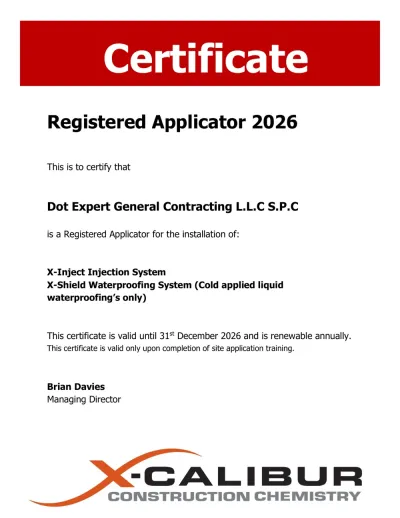
Registered Applicator
X-Calibur Construction Chemistry
Dot Expert is a registered applicator of X-Calibur Construction Chemistry. Our team has completed the manufacturer's site application training and installs its injection and liquid waterproofing systems to X-Calibur's application standards.
- X-Inject Injection System
- X-Shield Waterproofing System (cold-applied liquid waterproofing)
How It Works
-
Defect Survey & Site Assessment
We map every active leak, seepage point, and crack across the affected walls and floor slabs — classifying each as a structural crack, shrinkage crack, cold joint, or penetration sleeve — and identify the optimal injection points.
-
Surface Prep, Drilling & Packer Installation
Surfaces are prepared and sealed to confine the injection, then ports are drilled at 45° to the surface, intersecting the crack at the mid-point of its depth. Mechanical packers are installed and pressure-tested before injection begins.
-
Precision Injection
Resin is injected sequentially packer by packer — starting at the lowest point on vertical surfaces — at a minimum pressure of 4 bar (0.4 N/mm²), until the crack is fully saturated and active leakage stops.
-
Cure Check, Reinstatement & Documentation
Treated areas are re-inspected after cure for residual seepage, re-injected if needed, then packers are removed and port holes and floor recesses are reinstated with non-shrink repair mortar or grout, finished to match the surrounding surface. A completion report and warranty are issued.
Why UAE Concrete Structures Develop Water Leaks
Abu Dhabi's built environment creates specific conditions that accelerate water ingress through concrete. High-salinity groundwater — with chloride concentrations well above international averages — attacks concrete reinforcement and opens capillary pathways over time. The region's extreme thermal cycle (cold winter nights to 45°C+ summer days) causes repeated expansion and contraction in concrete, progressively widening microcracks. Flash flooding events push water under sustained hydrostatic pressure against below-grade structures that were not designed for long-term saturation.
Surface membranes applied during original construction typically fail within 10–15 years under these conditions. When they fail, the only effective remediation is sealing from inside the structure — where the water pressure acts. Injection waterproofing is the established international method for sealing leaking cracks and joints in below-grade concrete from inside (EN 1504-5, ACI 224.1R), and the technically correct response to this specific failure mode.
Documented Verification — Survey Before, Check After
A recorded survey before treatment and a documented check after cure — not just a surface that looks dry.
Pre-Treatment Defect Survey
Before treatment we survey and record every active leak, seepage point and crack with photographs and a marked-up layout, classifying each defect so the injection plan targets the source, not just the visible stain.
Post-Treatment Verification
After the resin has cured, the treated areas are re-inspected against the survey record and photographed before sign-off, and any point still showing water is re-injected. The record is part of your completion report.
Frequently Asked Questions
Guides for facility managers
Add Dot Expert to your approved contractor list
Tell us about the building and the problem, or ask for our company profile and vendor registration documents.